



Subtotal $0.00
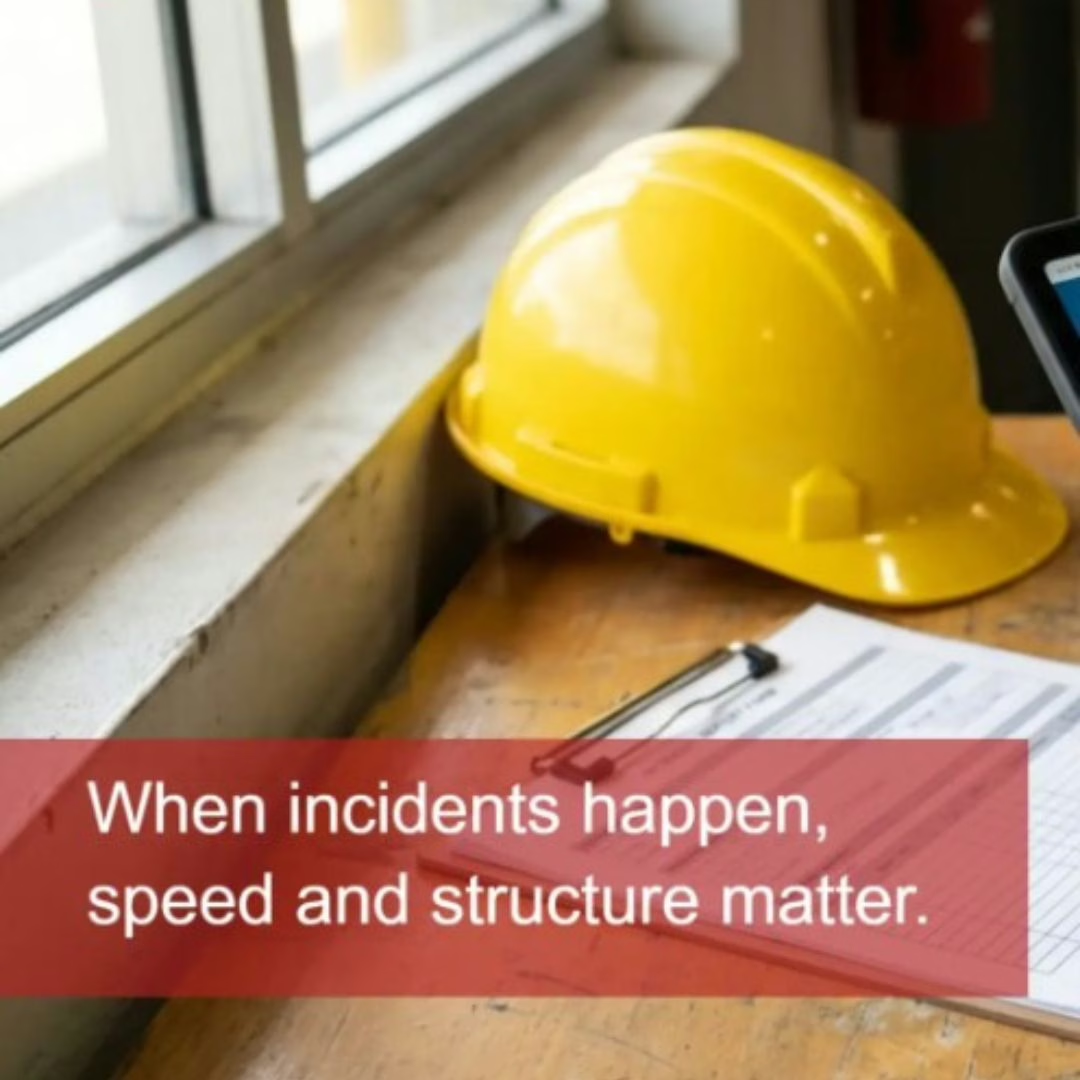
Every year, millions of workers are affected by incidents that could have been prevented with better planning, clearer responsibilities, and consistent oversight. Safety failures rarely happen because organizations do not care. They happen because systems are fragmented, risks are underestimated, or controls are applied inconsistently. The ISO 45001 management system was introduced to address this exact gap by transforming occupational health and safety into an integrated, ongoing process rather than a one-time compliance exercise.
ISO 45001 does not exist to generate certificates. It exists to help organizations identify hazards early, involve workers meaningfully, and respond to risks before they escalate into serious harm. When implemented with clarity and intent, it becomes a practical framework that supports safer decisions every day.
Why a Structured Safety System Matters More Than Ever
Modern workplaces are complex. Contractors, changing work environments, time pressures, and regulatory demands all interact in ways that increase risk. Traditional safety approaches often rely on static documents, periodic audits, or manual tracking, which can quickly fall out of date.
A structured safety management system software approach allows safety to evolve alongside operations. ISO 45001 emphasizes leadership commitment, worker participation, and continuous improvement, recognizing that safety performance depends on how systems behave under real conditions, not ideal ones.
By focusing on processes rather than isolated actions, organizations gain better visibility into how risks are created, controlled, and reviewed over time.
Understanding ISO 45001 Beyond the Standard Text
One of the challenges organizations face is translating ISO language into daily practice. The clauses are comprehensive, but without context, they can feel abstract. An effective ISO 45001 implementation guide bridges this gap by connecting requirements to real operational activities such as risk assessments, incident investigations, and corrective actions.
Rather than treating clauses as independent checkboxes, ISO 45001 encourages organizations to see how leadership, planning, support, operations, performance evaluation, and improvement interact. When these elements are aligned, safety controls become proactive rather than reactive.
Clear interpretation could help teams move away from reactive fixes and toward systematic prevention.
The Role of Digital Systems in ISO 45001 Consistency
Consistency is one of the most difficult aspects of safety management. Policies may be well written, but without visibility and follow-up, they lose effectiveness. This is where ISO 45001 management software plays an important role.
Digital systems centralize risk registers, audits, incident records, and corrective actions, making them accessible and traceable. Instead of relying on disconnected spreadsheets or paper files, organizations can track safety performance in real time. Automated alerts and dashboards provide early warnings when controls fail or actions remain open.
Over time, this structured oversight could help reduce repeated incidents and improve accountability across teams.
Connecting Occupational Health and Safety With Business Operations
Effective safety management does not operate in isolation. Decisions related to quality, productivity, and environmental impact often influence workplace risk. This is why many organizations integrate ISO 45001 with ISO 9001 for quality and ISO 14001 for environmental management.
An integrated approach allows leadership to evaluate how operational changes affect people, processes, and the environment simultaneously. This broader view strengthens occupational health and safety management software systems by ensuring safety considerations are embedded into planning and execution, not added later.
When systems are aligned, audits become more efficient, reporting becomes clearer, and improvement initiatives are easier to prioritize.
Learning From Data, Not Just Incidents
ISO 45001 places strong emphasis on performance evaluation. This includes monitoring leading indicators such as near misses, unsafe conditions, and audit findings, not only injuries or lost time incidents. Learning from early signals could help organizations intervene before serious events occur.
Digital reporting, non-conformance tracking, corrective and preventive action workflows, and trend analysis all support this approach. Access to detailed reports and automated alerts ensures that issues are not overlooked and that responsibility for resolution is clearly assigned.
With the support of mobile-accessible applications for NC, CA, and reporting, safety information becomes easier to capture and act upon, even in dynamic work environments.
From Compliance to Continuous Improvement
Certification is often the starting point, not the destination. The real value of ISO 45001 lies in how effectively it is maintained and improved. Regular management reviews, worker feedback, and performance analysis allow organizations to adapt to changing risks.
A mature ISO 45001 management system encourages learning, transparency, and shared ownership of safety outcomes. When workers see that their input leads to action, engagement increases. Over time, this creates a culture where safety is part of how work is done, not something enforced externally.
Digital tools and structured workflows could help sustain this consistency by reducing reliance on individual memory and manual follow-up.
Making ISO 45001 Practical and Sustainable
Implementing ISO 45001 does not need to be overwhelming. Breaking the standard into understandable processes, supported by connected systems, makes it easier to apply in daily operations. When safety activities are embedded into workflows, they are more likely to be completed accurately and on time.
Solutions like EHA Soft’s ISO 45001 Made Simple focus on turning complex requirements into usable systems that support risk management, audits, non-conformances, corrective actions, and reporting in one connected environment. With real-time dashboards, alerts, and detailed reporting, organizations gain clearer insight into safety performance and areas for improvement.
For organizations seeking to strengthen safety outcomes while aligning with quality and environmental standards, exploring a practical, digital approach to ISO 45001 could help build a system that delivers consistency, not just compliance.
Reach out today to start your trial.
Book your personalized demonstration today
🚀 Start a trial today and see how our platform can support your safety goals!
📧 info@ehasoft.com | 🌐 www.ehasoft.com
📞 USA: +1 (941) 337-167
📞 IE: +353 21 4536034
📞 UK: +44 800 8021092
For more information on how our solutions could help your organization stay ahead, contact us today!

Comments are closed